Why gold and silver are compared
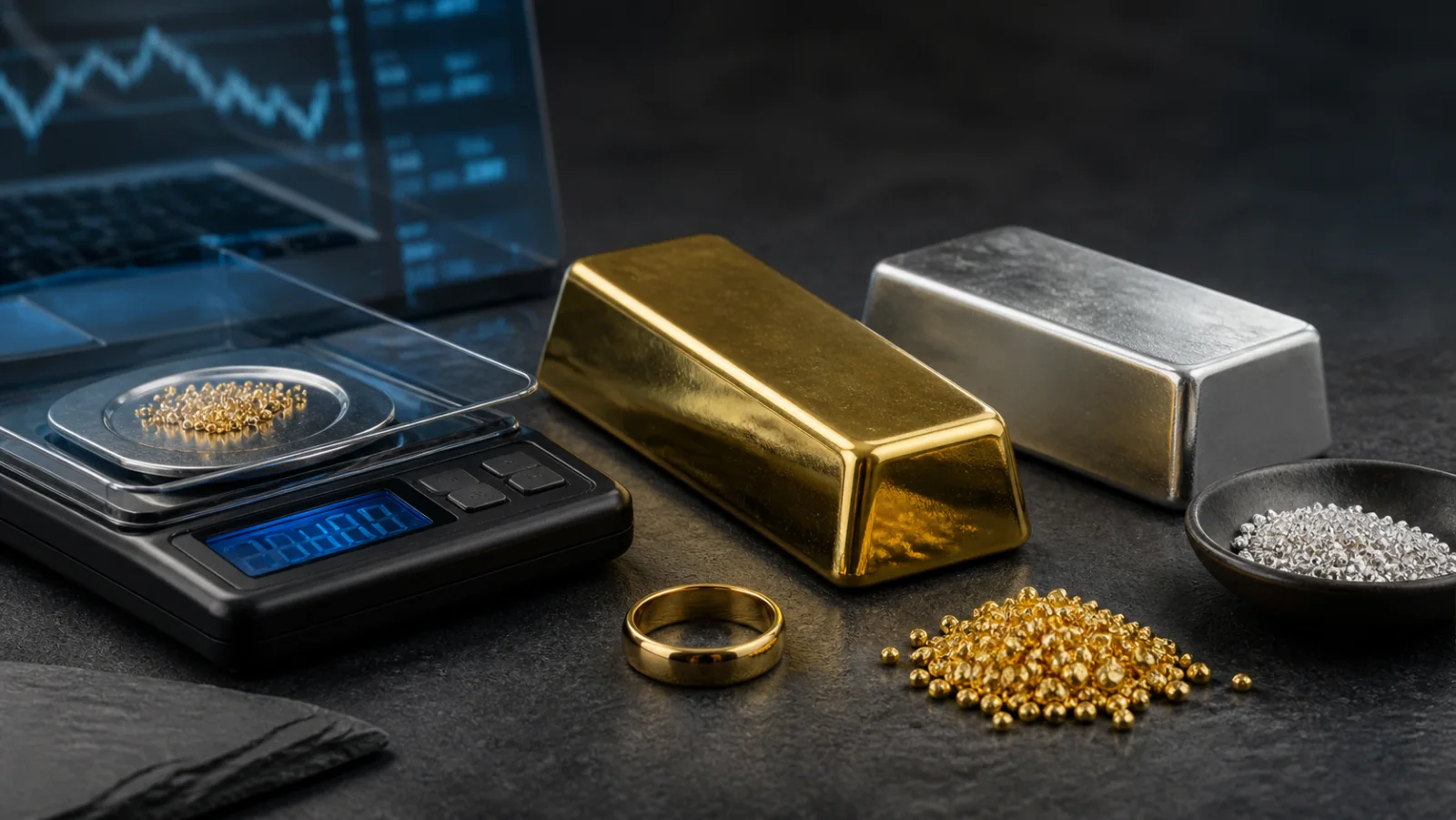
Gold and silver have served as stores of value, jewellery materials, industrial inputs, and monetary assets across centuries. Both trade internationally, are quoted by the troy ounce, and can be owned through physical products or financial instruments. Those similarities make comparison natural, but they should not obscure major differences in how each market functions.
A useful comparison separates the metal itself from the product used to gain exposure. A physical coin, an exchange-traded product, a futures contract, and shares in a mining company can all react to the same spot market while carrying very different custody, counterparty, operating, leverage, and liquidity risks.
Different demand structures
Gold has a broad demand base that includes investment, central-bank reserves, jewellery, and technology. Its price is influenced by currencies, real interest rates, inflation expectations, income growth, risk and uncertainty, investment flows, and supply. Different forces can dominate at different points in the cycle.
Silver also attracts investors and jewellery buyers, but industrial fabrication is a larger part of its demand story. Electronics, electrical infrastructure, solar applications, vehicles, brazing alloys, and other manufacturing uses connect silver more directly to industrial growth, technology choices, substitution, and business cycles.
Price behavior and volatility
Silver’s market is smaller in value and its industrial component can amplify changes in expectations. In practice, silver has often experienced larger percentage moves than gold in both directions. That can create opportunity, but it also means a position may fall further or require more tolerance for short-term price swings.
Gold can also be volatile and should not be treated as a guaranteed safe asset. Changes in real yields, currency strength, investor positioning, liquidity, and geopolitical risk can move its price sharply. Historical labels such as safe haven describe tendencies in certain conditions, not a promise for every day or every crisis.
Industrial exposure: feature and risk
Industrial demand gives silver participation in long-term themes such as electrification and photovoltaic production. It also exposes the metal to factory cycles, inventory adjustments, thrifting, recycling, and technological substitution. Strong end-use growth does not automatically translate into a higher price if supply, inventories, or investor flows move in the opposite direction.
Gold’s direct industrial share is smaller, although its conductivity, durability, and corrosion resistance support specialized technology uses. Its market therefore tends to be discussed more through investment demand, jewellery consumption, central-bank activity, the dollar, and the opportunity cost of holding a non-yielding asset.
Physical ownership costs
Because silver normally has a much lower value per unit of weight, the same monetary amount occupies more space and weighs more. Storage, shipping, insurance, and handling can therefore be proportionally more important. Retail silver products may also carry wider percentage premiums over spot, especially for small coins or during periods of constrained inventory.
Gold is more value-dense, which can simplify physical custody for a given monetary amount. Small gold products can still have meaningful fabrication premiums, and selling may involve assay, authentication, shipping, dealer spreads, or taxes. Compare the round-trip cost: purchase price above spot plus the likely discount or fee when exiting.
Purity, product form, and verification
Bullion products identify weight and fineness, while jewellery contains design value and may use lower-purity alloys. Gold is commonly discussed in karats or fineness; investment silver is commonly sold at high fineness. The market value of a physical item depends on authentic weight and purity, not merely its color or seller description.
Use reputable counterparties, retain invoices and assay information, understand storage arrangements, and confirm whether a quoted price is per troy ounce of fine metal or per gross product weight. Collectible coins require numismatic expertise because rarity and condition can outweigh the metal value.
The gold-silver ratio
The gold-silver ratio divides the gold price per troy ounce by the silver price per troy ounce. A ratio of 70 means one ounce of gold is priced like 70 ounces of silver. Traders use it as a relative-price indicator, but it has no fixed fair value and can remain unusually high or low for long periods.
The ratio is descriptive, not a complete investment rule. It ignores storage costs, product premiums, taxes, liquidity, industrial conditions, income needs, and personal risk capacity. A changing ratio can result from gold moving, silver moving, or both moving for different reasons.
A decision framework without price predictions
Start with purpose: short-term speculation, long-term diversification, collectability, jewellery use, or a physical emergency reserve are different objectives. Then compare volatility tolerance, position size, custody, liquidity, premiums, tax treatment, and the reliability of the chosen product and counterparty.
Use live gold and silver pages to normalize both metals into the same currency and unit. Record the source and timestamp, compare dealer buy and sell prices with spot, and avoid making a decision from a single ratio or forecast. For a material allocation, regulated professional advice may be appropriate for your jurisdiction and circumstances.
Frequently asked questions
Is silver always more volatile than gold?
Not every day, but silver has often shown larger percentage swings because of its smaller market and its combination of investment and industrial demand. Historical behavior does not guarantee future volatility.
What is the gold-silver ratio?
It is the gold price per troy ounce divided by the silver price per troy ounce. It describes their relative market prices but does not establish a fixed fair value.
Why can physical silver cost more than the spot calculation?
Fabrication, minting, wholesale and retail margins, shipping, insurance, taxes, and local inventory conditions can add a premium above the wholesale spot benchmark.
Are gold and silver guaranteed inflation hedges?
No. Both prices can rise or fall over short and long periods. Their response depends on multiple forces including currencies, real rates, investor flows, economic activity, supply, and risk sentiment.
Sources and methodology
This educational article uses unit standards and market context from the following primary or specialist sources. Worked prices are hypothetical unless explicitly identified as live data.